
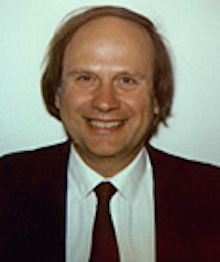
Harvard Title
Associate Professor of Medicine
Administrative and Hospital Titles
Director, Cardiology Grand Rounds
Address
Harvard Institutes of Medicine
77 Avenue Louis Pasteur, Room 223
Boston, MA 02115
Publications View
QRST-wave alternans in a child with type 3 long-QT syndrome: an ominous ECG pattern appearing during transition from T-wave alternans to polymorphic VT.
Authors: Goto H, Takasugi N, Kuwahara T, Verrier RL.
J Cardiovasc Electrophysiol
View full abstract on Pubmed
J Cardiovasc Electrophysiol
View full abstract on Pubmed
Is there a role of MMA T wave alternans test for risk assessment in Brugada syndrome?
Screening entire health system ECG databases to identify patients at increased risk of death.
Authors: Strauss DG, Mewton N, Verrier RL, Nearing BD, Marchlinski FE, Killian T, Moxley J, Tereshchenko LG, Wu KC, Winslow R, Cox C, Spooner PM, Lima JA.
Circ Arrhythm Electrophysiol
View full abstract on Pubmed
Circ Arrhythm Electrophysiol
View full abstract on Pubmed
Ambulatory ECG-based T-wave alternans monitoring for risk assessment and guiding medical therapy: mechanisms and clinical applications.
Electrophysiology of T-wave alternans: mechanisms and pharmacologic influences.
Clinical applications of T-wave alternans assessed during exercise stress testing and ambulatory ECG monitoring.
Inhibition of I(f) in the atrioventricular node as a mechanism for dronedarone's reduction in ventricular rate during atrial fibrillation.
Authors: Verrier RL, Sobrado MF, Pagotto VP, Kanas AF, Machado AD, Varone BB, Sobrado LF, Nearing BD, Zeng D, Belardinelli L.
Heart Rhythm
View full abstract on Pubmed
Heart Rhythm
View full abstract on Pubmed
Ranolazine's sweet side--improvement of glycaemic control by the novel mechanism of skeletal muscle microvascular recruitment.
T-wave alternans, QRST-wave alternans and atrioventricular block: three consecutive rate-dependent phenomena in a child with congenital long-QT syndrome.
Authors: Goto H, Takasugi N, Verrier RL, Kuwahara T.
J Cardiovasc Electrophysiol
View full abstract on Pubmed
J Cardiovasc Electrophysiol
View full abstract on Pubmed
Dronedarone's inhibition of If current is the primary mechanism responsible for its bradycardic effect.
Authors: Sobrado LF, Varone BB, Machado AD, Nearing BD, Zeng D, Belardinelli L, Verrier RL.
J Cardiovasc Electrophysiol
View full abstract on Pubmed
J Cardiovasc Electrophysiol
View full abstract on Pubmed